Anthony’s unresolved longing for Steph
And Their Children After ThemAnthony’s unresolved longing for Stéphanie Chaussoy survives as a private routine and, finally, as a direct confession that cannot change the past. He circles Heillange at night, drawn toward her neighborhood, then watches the house from a distance; when he tells her he thinks about her all the time, she turns away. The rejection gives a persistent, largely unspoken desire a clear ending, but not an immediate release: afterward, Anthony feels her absence in his body and must face the continuation of ordinary life without her.
A private ritual of longing
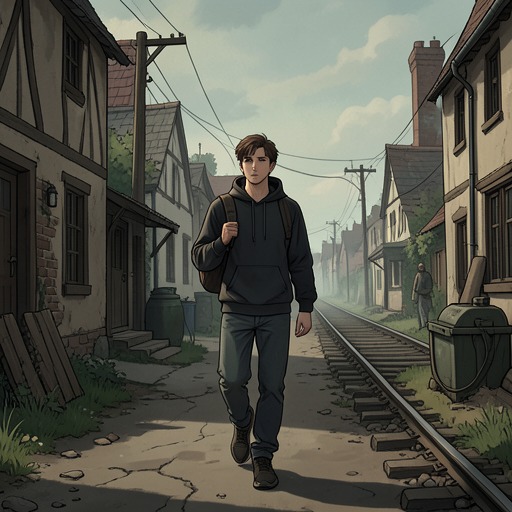
Anthony does not speak openly about his feelings. Instead, on nights when he has drunk more than usual, he takes a beer downstairs from his one-bedroom apartment, gets into his Clio Williams, finds something on the radio, lights a cigarette, and drives north toward Stéphanie’s neighborhood. He follows the docks along the Henne Valley and the familiar streets of his hometown. The drive is deliberate but unhurried, a repeated passage through places he knows by heart.
Music gives the journey its emotional register. Old songs on FM, especially those of Johnny Hallyday, bring up disappointment, failed love, loneliness, and the passage of time. Anthony lets himself become absorbed in those feelings while the streetlights punctuate the route. The night drive offers him a way to approach the subject of his longing without having to name it or address Stéphanie directly.
Heillange as a map of memory
The drive crosses not just distance but Anthony’s past. He passes the enormous steel mill caught in spotlights, bus shelters where he spent much of his childhood waiting for school, his old school, kebab stands, and the train station from which he left and to which he returned defeated. Bridges where he used to spit into the river out of boredom lead into a landscape of betting shops, McDonald’s, empty tennis courts, and a dark swimming pool. Familiarity makes the route intimate, while its succession of industrial, commercial, and residential places registers how much of his life remains bound to Heillange.
The journey gradually carries him toward Stéphanie without any declared plan. Near her house, he turns up the music, takes a sip of beer, and looks from afar at the Chaussoys’ beautiful home, with its grille and electronic gate lock. He wonders whether she is there, but expects that she probably is not. He does not approach the entrance or seek an encounter: he smokes, lets his thoughts drift, and eventually drives home. The house’s visible boundary makes the distance between them concrete; his recurring proximity never becomes access.
The confession and refusal
The private ritual culminates when Anthony sees Stéphanie again and asks whether she wants to go for a short drive. She refuses. Touching his left eyelid, an old reflex, he recognizes that he has no further chances and struggles to get his words out. Stéphanie tells him that it is all over. Anthony takes a deep breath, puts his hands in his back pockets, and tells her that he thinks about her all the time. Her stiffening response and declaration that he is dreaming make clear that his confession is not a beginning or an invitation to resume their relationship.
Stéphanie turns her back and goes inside, saying that she must get up early. Her departure is also a movement toward a future elsewhere: in a few days she is due to fly to Canada, where her boyfriend is waiting in Ottawa after finishing a journalism degree and beginning a newspaper internship. Although she is meant to stay for only three weeks, she secretly plans to enroll at university and work as a waitress. The new country represents a direction Anthony’s attachment to Heillange cannot follow. He says goodbye, but does not even see her face; she raises a hand in farewell and disappears behind the closing door.
Absence and continuation
After she has gone, Anthony’s memory returns to her ponytail on a July day and to her silhouette framed by the doorway. The recollection turns their separation into a final image and fixes what he has lost in physical terms: he will never touch her breasts again. Desire is not softened into a promise of future reunion; its bodily specificity underlines the finality of the refusal.
Anthony then leaves on his motorcycle. The narrative dwells on its reliable mechanism: a spark ignites the fuel mixture, the piston rises and falls, and the cycle repeats as long as the engine runs and gasoline flows. Its capacity to produce speed and forgetfulness contrasts with the emotional repetition of his drives toward Stéphanie’s house. Later, alone in his apartment, he drinks whiskey before work and dinner with his mother. In the bathroom, under scalding water that eventually turns cool, he feels Stéphanie’s absence in his chest and belly. Life will go on, he recognizes, and that continuation is the hardest part. His longing has been exposed and refused, but its ending does not erase the attachment at once.